Businesses hire commercial cleaning services to maintain consistent hygiene standards, reduce employee sick days, present a professional appearance to clients, access commercial-grade equipment and products, and shift cleaning liability to an insured provider. Professional cleaning also frees staff from non-core tasks and extends the life of flooring, fixtures, and surfaces.
Most businesses start out handling cleaning in-house. Staff wipe down surfaces, empty bins, and run a mop through the bathroom at the end of the day. It works until it does not, and when it stops working the problems tend to compound quickly.
This guide covers the practical reasons why businesses move to professional commercial cleaning services, what the difference in outcome actually looks like, and which types of businesses benefit most from making that shift.
Key Takeaways
- Commercial cleaning services use equipment and disinfectants not available to most businesses through consumer retail channels.
- A visibly clean workplace affects how clients, customers, and prospective employees perceive the business before any conversation takes place.
- Having staff clean their own workplace diverts time from their actual roles. The cost in lost productive hours is often higher than the cost of a professional cleaning contract.
- Professional cleaning companies carry general liability insurance and bonding. If something is damaged or an accident occurs during a cleaning visit, the liability rests with the cleaning provider.
- Consistent professional cleaning slows the deterioration of flooring, upholstery, and surfaces, reducing long-term replacement costs.
- Certain industries including food service, healthcare, and childcare have regulatory hygiene requirements that in-house cleaning often cannot reliably meet.
1. Professional Cleaning Reaches a Standard That In-House Cleaning Does Not
There is a meaningful difference between a workspace that looks clean and one that is hygienically clean. High-touch surfaces such as door handles, light switches, elevator buttons, shared keyboards, and communal kitchen equipment carry significant bacterial loads even when they appear clean to the eye.
Research from the University of Arizona found that a single sick employee can contaminate up to 50 percent of commonly touched surfaces in an office within the first few hours of arrival. Standard in-house wiping with consumer products does not consistently address this because the products lack sufficient dwell time or concentration, and staff apply them inconsistently.
Commercial cleaning providers use hospital-grade disinfectants with verified kill rates against common pathogens and follow structured protocols that ensure high-touch areas are addressed on every visit. The result is a measurably lower pathogen load in the workspace, not just a visually cleaner one.
High-Touch Surfaces Most Often Missed in In-House Cleaning
- Door handles and push plates
- Light switches and electrical panel covers
- Shared keyboards, mice, and office phones
- Breakroom appliance handles and microwave buttons
- Elevator buttons and stair handrails
- Restroom flush handles, faucet handles, and paper towel dispensers
2. Cleaner Workplaces Are Linked to Fewer Employee Sick Days
Workplace illness spreads through contact with contaminated surfaces and through airborne particles in shared spaces. The Centers for Disease Control and Prevention (CDC) identifies contaminated surfaces as a significant transmission route for common respiratory illnesses, including colds and influenza.
A study published in the American Journal of Infection Control found that regularly disinfecting commonly touched workplace surfaces reduced the spread of common cold viruses by up to 80 percent. In a business context, that translates directly to fewer sick days, reduced absenteeism, and more consistent team productivity.
The cost of absenteeism to US employers is estimated at over $225 billion per year according to the CDC. While no single measure eliminates sick days, maintaining a consistently hygienic workplace environment is one of the more actionable factors a business controls directly.
3. Workplace Cleanliness Affects How Clients and Customers Perceive Your Business
A 2017 survey by Cintas Corporation found that 94 percent of people said they would avoid a business in the future after encountering a dirty restroom. For businesses that receive clients, customers, or visitors on site, the cleanliness of the space communicates something before any conversation begins.
This applies beyond restrooms. Visible dust on surfaces, streaked windows, stained flooring, and overflowing bins in common areas all signal a level of operational care that clients extend, fairly or not, to other aspects of how the business operates.
For retail spaces, medical practices, professional service offices, and hospitality businesses, cleanliness directly influences purchasing decisions and return visits. It is not a secondary concern for these business types.
4. Commercial Cleaners Use Equipment and Products Not Available in Retail Channels
The cleaning products and equipment available to businesses through standard retail channels are consumer-grade. Commercial cleaning companies use industrial concentrates, commercial-grade disinfectants, and equipment designed for sustained daily use at a scale that consumer products are not built to match.
| In-House Cleaning | Professional Commercial Cleaning |
|---|---|
| Consumer-grade multipurpose sprays | Hospital-grade disinfectants with verified pathogen kill rates |
| Standard mop and bucket | Commercial auto-scrubbers and wet vacuums for large floor areas |
| Consumer vacuum cleaner | HEPA-filtered commercial vacuums for allergen capture |
| General-purpose paper towels and cloths | Microfiber systems that capture rather than redistribute bacteria |
| Off-the-shelf restroom cleaner | Color-coded sanitation systems to prevent cross-contamination |
| Basic carpet spot cleaner | Truck-mounted or portable hot water extraction equipment |
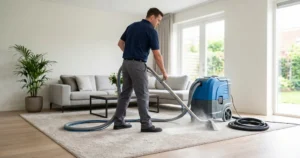
This equipment difference is most visible in flooring. Commercial carpet extraction equipment removes soil at a depth that consumer machines cannot reach. Commercial hard floor scrubbers clean and dry large areas in a fraction of the time a mop and bucket would take, and they do so more consistently across the whole surface.
5. It Frees Staff from Non-Core Tasks
When cleaning is assigned to existing staff, it is paid for at that staff member’s hourly rate regardless of their role. A customer service representative, an administrative assistant, or a retail associate spending 30 minutes cleaning at the end of a shift is costing the business at their employment rate for work that falls entirely outside their job function.
This is a hidden cost that businesses often do not account for when comparing the apparent expense of a professional cleaning contract against the apparent savings of in-house cleaning. Once staff time, cleaning supplies, and equipment maintenance are included in the in-house cost calculation, the gap between the two options typically narrows significantly.
Beyond direct cost, asking staff to clean affects morale. Employees hired for specific roles are less engaged and less effective when regularly assigned tasks that are outside those roles.
6. Professional Cleaning Services Carry Insurance and Bonding
A reputable commercial cleaning company carries general liability insurance and bonding. General liability insurance covers damage to your property caused during a cleaning visit. Bonding provides financial protection in cases involving theft or dishonesty by a cleaning employee on your premises.
When a business handles cleaning in-house and an employee slips on a wet floor they mopped themselves, or accidentally damages property while cleaning, the liability and cost rest entirely with the business. With a professional cleaning provider, those scenarios fall under the provider’s insurance coverage.
This is particularly relevant for businesses that operate in industries with higher liability exposure, including medical offices, food service, and facilities that receive large numbers of visitors.
7. Consistent Professional Cleaning Extends the Life of Surfaces and Flooring
Soil and grit left on hard flooring act as an abrasive underfoot. Every step grinds particulate matter against the floor surface. On hardwood, tile, and vinyl this creates micro-scratching that dull the finish over time. On carpet, embedded soil cuts carpet fibers at the base, accelerating matting and thinning.
Regular professional cleaning removes this abrasive load before it accumulates to a damaging level. The result is flooring and surfaces that retain their appearance and function for longer, which defers the significant cost of replacement.
The same applies to upholstered furniture, restroom fixtures, and breakroom surfaces. Soil and residue that are not removed consistently cause staining and deterioration that becomes harder to reverse the longer it is left.
8. Some Industries Have Hygiene Requirements That Professional Cleaning Helps Meet
Certain business types operate under regulatory hygiene and sanitation standards set by bodies including local health departments, OSHA, and industry-specific regulators. Food service businesses, medical and dental practices, childcare facilities, and pharmacies are subject to inspection standards that require documented and consistent cleaning protocols.
Professional commercial cleaning companies operating in these sectors maintain cleaning logs, use products appropriate for regulated environments, and follow documented protocols that support compliance during inspections. In-house cleaning arrangements rarely produce this level of documentation or consistency.
A failed health inspection or sanitation citation does not just carry a financial penalty. In food service and healthcare, it can result in temporary closure or reputational damage that affects the business long after the citation is resolved.
Professional Cleaning vs In-House Cleaning: A Practical Comparison
| Factor | In-House Cleaning | Professional Cleaning Service |
|---|---|---|
| Cleaning standard | Variable; depends on staff availability and diligence | Consistent; follows a defined scope of work each visit |
| Products and equipment | Consumer-grade, limited effectiveness at scale | Commercial-grade; matched to surface type and sanitation requirement |
| Cost visibility | Often underestimated; staff time and supplies frequently overlooked | Clear contract pricing; easier to budget and evaluate |
| Liability | Business bears liability for accidents and damage | Covered by provider’s general liability insurance and bonding |
| Staff impact | Diverts employees from their primary roles | No impact on staff; cleaning handled outside business operations |
| Compliance documentation | Rarely maintained | Logs and protocols available for regulated industries |
| Surface longevity | Inconsistent removal of abrasive soil | Regular removal of particulate load extends surface life |
Which Types of Businesses Benefit Most from Commercial Cleaning?
Professional commercial cleaning is relevant to almost any business that operates from a physical premises. The benefit is proportionally higher for businesses with the following characteristics:
- High foot traffic: Retail spaces, gyms, clinics, and hospitality venues accumulate soil faster than low-traffic offices. More frequent and thorough cleaning is necessary to maintain an acceptable standard.
- Client-facing environments: Any business where clients, customers, or visitors enter the premises. First impressions formed in the first few seconds of arrival are disproportionately influenced by the cleanliness of the space.
- Food service or food handling: Health code compliance, grease management, and sanitation of food-contact surfaces require standards that general in-house cleaning cannot consistently achieve.
- Medical and dental practices: Cross-contamination risk and regulated sanitation requirements make professional cleaning with appropriate disinfection protocols particularly important.
- Large office buildings and co-working spaces: Scale alone makes in-house cleaning impractical. Commercial equipment and organized scheduling are necessary to maintain a standard across a large floorplate.
For businesses in Louisville, KY looking into janitorial and commercial cleaning services, you can view available services or request a quote based on your facility type and size.
Frequently Asked Questions
Is it worth hiring a commercial cleaning service for a small business?
For most small businesses that receive clients or customers on site, yes. The cost of a professional cleaning contract for a small space is typically lower than the combined cost of staff time, supplies, and equipment used in an in-house arrangement. Beyond cost, professional cleaning produces a more consistent result and removes the liability that comes with assigning cleaning tasks to employees.
How is commercial cleaning different from regular cleaning?
Commercial cleaning uses industrial-grade equipment and disinfectants, follows structured protocols across defined areas, and is carried out by trained staff on a scheduled basis. It covers larger areas more efficiently than consumer cleaning methods and addresses hygiene at a level, such as verified pathogen kill rates on high-touch surfaces, that general cleaning does not reach. Commercial cleaning providers also carry professional liability insurance, which standard in-house cleaning arrangements do not provide.
How often does a business need professional cleaning?
Frequency depends on the type of business and how the space is used. A low-traffic professional office may be well-served by two to three visits per week. High-traffic retail, medical, or food service environments typically require daily cleaning to maintain hygiene and appearance standards. Common areas such as restrooms and reception zones in any business type generally need more frequent attention than private offices or storage areas.
Can I use the same cleaning company for office and carpet cleaning?
Many commercial cleaning providers offer both routine janitorial services and specialty services such as carpet and upholstery cleaning under the same contract or as add-ons scheduled at a separate frequency. Using one provider for both simplifies scheduling and accountability, since there is a single point of contact for all cleaning-related work in the facility.
What should a commercial cleaning contract include?
A commercial cleaning contract should include a written task checklist specifying exactly what is covered in each visit, the cleaning frequency, which areas of the facility are in scope, restocking responsibilities, how add-on services are scheduled and priced, and the provider’s insurance and bonding details. A contract without a detailed scope of work creates room for misaligned expectations that are difficult to resolve once the service is underway.